|
Dragonfly, Dragonflies
|
| Except for butterflies, there are few more attractive and graceful insects than the "dragonflies." They are insects which have always attracted attention, and have been known by a variety of vernacular names, of which dragonfly is the most common in English. Dragon-flies have been known in some parts of the country as "devil's darning needles;" elsewhere as "snake feeders" or "snake doctors," in Scotland as "flying adders," and in some parts of England as "horse stingers." |
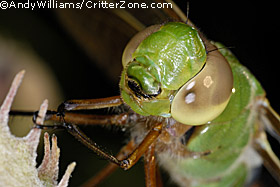 Green Darner, Anax junius, face, closeup
|
| Although the insects are perfectly harmless, these names well indicate the existence of numerous popular superstitions. A century or longer ago there were people that believed that they would sew up the ears of bad boys; others that they sting horses; still others that they act as feeders and physicians to snakes, especially to water snakes. |
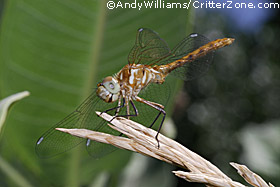
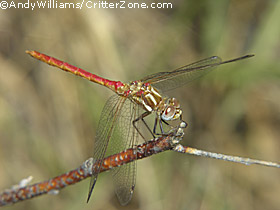
| The Odonata are slender insects with a very large head which moves most easily upon its slender neck, even rotating to a considerable extent. The eyes are very large, but the antennas are small and short. The wings are elongate, nearly equal in size, and have many veins, both longitudinal and transverse. The entire surface of the wing is cut up into many small cells. The legs are placed near the front of the thorax. All legs curve forward and are used for grasping the prey of the dragonfly, and never for walking. |
 dragonfly
|
| In fact, the legs are not designed for walking, although they are used to grasp twigs or other objects upon which the dragon-fly may rest. All of the dragonflies are aquatic in their early stages of life. The jaws in all stages are strong, and both larvae and adults are extremely active. Dragonflies are among the strongest and most graceful flyers of all insects. |
| A very peculiar feature of the adult is the curious separation in the male of the intromittent organs from the opening of the ejaculatory duct. The former are placed on the under side of the second abdominal segment, while the latter are on the next to the last ventral plate. Therefore, before copulation, the male curves his abdomen around beneath, so that the ninth segment of the abdomen is brought into contact with the second, thus transferring the fertilizing fluid to the intromittent organ. |
 dragonfly
|
| The tip of the abdomen of the female is bent around and joins with the under side of the second segment of the male's abdomen, the male frequently grasping the female around the neck with certain appendages at the extremity of his abdomen. He retains this hold after fertilization, and frequently during the entire process of egg laying. Even with such species as descend under the surface of the water to lay their eggs the male has been observed to still retain his grasp of the female's neck, and to be carried down underwater with her. |
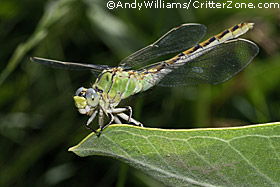
| Dragon-flies capture their prey on the wing, and feed upon almost all flying insects, especially the small ones like gnats and midges. They alter their flight direction with perfect agility, and dart here and there, unerringly capturing their prey. Possibly some of the smallest are seized with the jaws, but the larger ones are undoubtedly captured by the legs, and are consumed during flight. This hunting process is done so rapidly, it is nearly impossible to see the operation. |
 dragonfly
|
| Flies seem to be their commonest food, but large dragonflies will eat smaller ones. Leaf-hoppers and even small butterflies and moths are captured by them. Some dragonflies will occasionally pick up a moth from a weed or a grass stem on which it is resting, and even one of the large swallowtail butterflies has been seen captured by a dragon-fly. |
| Although dragonflies are frequently very abundant in swampy regions and around ponds, there are times when they swarm in vast numbers, Koppen, a German entomologist, published a chronological account of the records of dragonfly migrations, from 1494 to 1868. Such migrating swarms seem to have been more frequently noticed in Europe than in this country, but several had been noticed in the United States a century ago. |
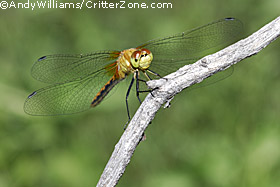 dragonfly
|
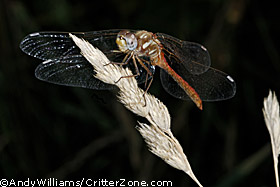 dragonfly
|
| Among the insects killed by dragonflies there must be, of course, some mosquitoes, although the beneficial work of these insects in this direction is greater in the larval stage than in the adult. Dragonflies are day flyers, generally unlike mosquitoes, but in cloudy weather and toward evening many mosquitoes are undoubtedly killed by dragonflies. |
| Dragonfly eggs are laid either in the water or are inserted in the stem of some aquatic plant. In the dragonflies of two families there is no apparatus for the insertion of eggs into plant stems, and they are therefore either dropped loosely in the water or attached to submerged objects by means of a mucilaginous substance which surrounds them. With others, however, there is a curious modification of the end of the body. |
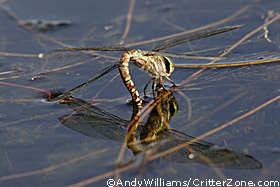 dragonfly laying eggs in water
|
| The sides of the vulva are pointed or roughened, and cut into plant tissue so that the eggs may be pushed into the cuts. Here the female gradually crawls down the stem of a water plant until she is often completely submerged. She is always encased with an air film so that she can continue to breathe underwater to a certain extent. The number of eggs is variable, but is usually large. |
| When the eggs hatch the young immediately begin an active, predatory life underwater, feeding on other aquatic insects. This eating habit is continued throughout the dragonfly's larval or nymphal existence. As the dragonfly larvae grow larger, they are able to overpower larger and larger insects and even small fish and other aquatic animals. They will kill others of their own kind, and nymphal dragonflies have been seen to catch and destroy adults in which the wings were not yet expanded. |
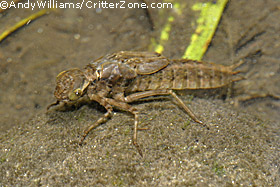 dragonfly larva underwater
|
| They molt probably a number of times. The most peculiar feature of the larva or nymph is the strange modification of the mouth. There has been a backward growth of the lower lip and this has become hinged so as to form a long, hinged apparatus with sharp teeth at its extremity. It can be folded to cover the lower face like a mask. The moment that the larva approaches near enough to its prey, the innocent looking mask is unfolded and darted out, and the unsuspecting aquatic insect or small fish is seized by the teeth at the extremity and drawn back into its mouth. |
| Dragonfly larvae breathe in a peculiar way modified to some extent with the members of the different families. The rectum is furnished with very many tracheal branches, forming numerous loops and even penetrating the walls of the intestine. Water is sucked into the rectum, and these "rectal gills," as they are termed, derive their oxygen from this water. This same feature affords with some species a means of locomotion. The water that is sucked in for breathing purposes may be ejected violently like a rocket booster, the effect of which is to send the larva ahead. With some dragonfly larvae, there are external abdominal gills, both lateral and caudal, that are used for respiration. When the nymph becomes fully grown and is ready to leave the water, its breathing is taken up by certain obscure spiracles. |
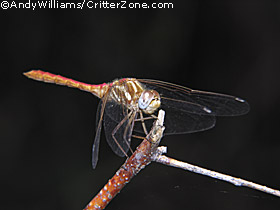 dragonfly
|
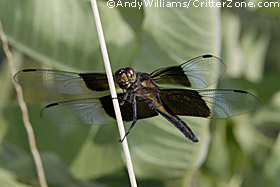 dragonfly
|
| When the nymph becomes fully grown, it has changed its form from a rather slender creature to a broad and flattened one, not resembling the slender bodied adults in the least. It crawls onto the pond edge or river bank and up the stems of water plants upon nearby rocks. Later the dragonfly nymph's skin splits down the back, and the adult dragonfly emerges. Empty skins of these nymphs can be commonly seen in the water.
|
In many places dragonflies have disappeared or are far fewer in number than in times past. This is due to the draining and filling of their breeding places. Luckily dragonflies can still be seen and enjoyed near remaining natural water deposits and increasingly around engineered ponds and lakes.
Andy Williams / CritterZone.com
|
The dragonfly photos on this page are available for commercial stock photography license. All photos and text that appears on this webpage is copyrighted and may not be copied or used in any way without permission from CritterZone. You can view more photos of dragonflies in our online gallery:
dragonfly, dragonflies, stock photos
CritterZone does not specifically endorse our advertisers, or their methods. We cannot control the ads that run on our articles. CritterZone advocates humane and respectful treatment of all creatures. |
Save this page:

|
